

Chicago summers are hard on everything — your AC, your patience in traffic on the Ike, and your transmission. If your car has started hesitating between gears, slipping when you accelerate, or just feels “off” once the temperature climbs past 85°F, you’re not imagining it. Heat exposes transmission problems that were already there, quietly getting worse.
Why Heat Makes Transmission Problems Worse
Transmission fluid does two jobs: it lubricates moving parts, and it transfers hydraulic pressure that actually shifts your gears. When that fluid gets too hot — which happens fast in stop-and-go Chicago traffic during a heat wave — it breaks down. Thinner, degraded fluid can’t hold pressure the way it should, and that’s when you start feeling:
- Delayed engagement — a pause before the car actually moves after you shift into drive
- Slipping — the engine revs up but the car doesn’t accelerate at the same rate
- Rough or hard shifts — a noticeable clunk or jolt between gears
- Burning smell — a sign the fluid has already overheated significantly
None of these are things to “wait and see” about. A transmission that’s slipping under heat stress today is a transmission that fails completely within weeks if the underlying cause isn’t fixed.
It’s Not Always the Whole Transmission
Here’s something most shops won’t tell you upfront: a lot of “transmission problems” aren’t a blown transmission at all. They’re a fluid issue, a failing solenoid, or a sensor sending bad data to the computer that controls your shifts. The only way to know which one you’re actually dealing with is a real diagnostic — not a guess, not an automatic recommendation to replace the whole unit.
That distinction matters because the cost difference is massive. A fluid service and flush might run you a couple hundred dollars. A full transmission replacement is a different conversation entirely. Anyone who tells you which one you need before they’ve actually pulled codes and inspected the vehicle is guessing — and you shouldn’t pay to be guessed at.
What a Real Diagnosis Looks Like
At Chicago Apex Motors, we don’t quote a transmission job off a phone call or a test drive alone. We pull the diagnostic codes, check fluid condition and level, inspect for leaks, and — when needed — road test under load to see exactly when and how the slipping happens. Then we walk you through what we found in plain language: what’s actually wrong, what it’ll cost to fix it right, and what happens if you wait.
That’s not a sales pitch. It’s just how you diagnose a transmission properly. If a shop skips straight to “you need a new transmission” without doing that work first, that’s worth questioning.
What to Do If You’re Feeling It Right Now
If your car is slipping, hesitating, or shifting rough in this heat:
- Don’t keep driving on it hard. Short trips at moderate speed are fine short-term; don’t tow anything or push it up steep grades until it’s checked.
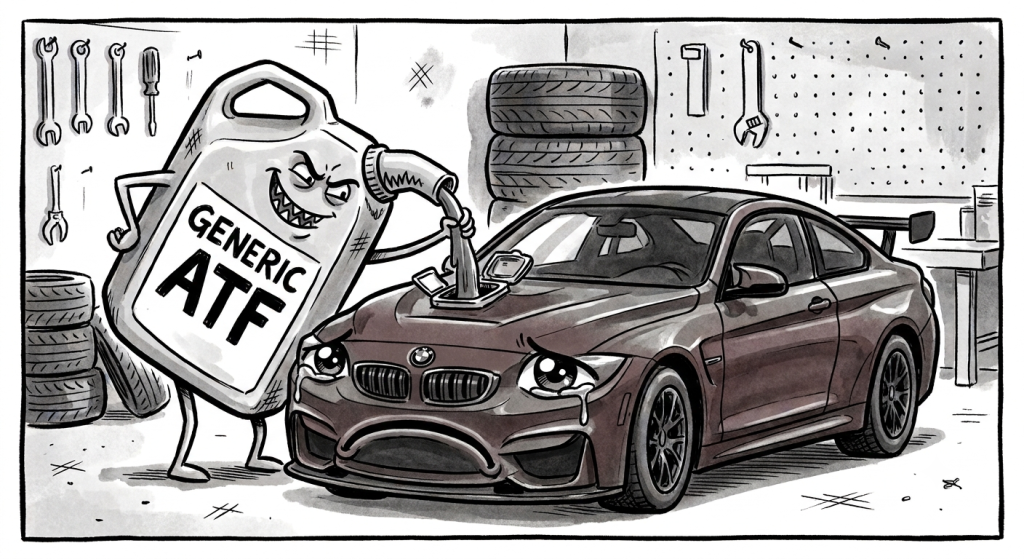
- Check your fluid level yourself if you’re comfortable (with the engine warm and running, per your owner’s manual). If you need to top it off, make sure you’re using a high-quality fluid compatible with your vehicle. For everyday commuter cars, a standard multi-vehicle full synthetic fluid from your local auto parts store works perfectly fine. however, if you are driving a high-performance build, towing heavy loads, or managing a modern European vehicle with an advanced multi-speed gearbox, generic fluid won’t cut it. You’ll need to invest in premium, ultra-stabilized formulas like Torco 100% Synthetic ATF or specialized ZF Lifeguard fluids to prevent thermal breakdown under extreme conditions. But don’t rely on a fluid top-off alone to fix a real problem — if there is a leak or internal damage, a top-off is just a temporary band-aid.
- Get it diagnosed before it gets worse. Heat accelerates whatever’s already wrong. A problem that’s manageable today can become a full transmission failure at month three. We pull the diagnostic codes using professional gear to read the deepest modules of your vehicle’s computer. But if you want to see what your car’s computer is crying about before you even get to a shop, having a simple Bluetooth OBD2 Scanner in your glovebox is an incredibly smart investment for any vehicle owner. However, if you’re a serious DIYer or running an independent garage and want the same professional-grade edge we use, investing in a high-end diagnostic system like the Launch X431 Pro Elite or and Autel MaxiSYS System allows you to perform deep bi-rectional control. transmission relearns, and solenoid testing right from your driveway.
One More Thing Worth Knowing: Your Warranty Still Works Here
If your vehicle is under an extended warranty or service contract, federal law (the Magnuson-Moss Warranty Act) protects your right to bring it to an independent shop like ours — your warranty can’t be voided just because you skipped the dealership. If you’re unsure what your specific plan covers for transmission work, you can review CARCHEX’s coverage guide to see exactly what standard vehicle service contract’s cover before you give us a call.
Straight Talk. Smart Work.
We diagnose before we quote — always. If your transmission is acting up in this heat, bring it to 632 N Cicero Ave or call us at (872) 813-2874. We’ll tell you exactly what’s happening and what your real options are — no pressure, no upsell games.
Let’s Talk Engines! — ¡Hablemos de Motores!